Former Atheist William Murray, Son of the Founder of American Atheists, Converts to Christianity.


Now deceased Madalyn, once known as the most hated woman in America and a title she apparently took great pleasure in (1), fought a war against school prayer and won. It was further ruled in her favour that official Bible-reading in American public schools in 1963 and onward would cease. According to her son Murray (now 70 years of age), as captured on film while still a school pupil during this whole affair, “I am an atheist, and I wish to be an atheist, and I don’t feel it would be appropriate for me to stand up and say the Lord’s Prayer” (2). Madalyn subsequently founded the American Atheists and sued the city of Baltimore demanding that the state collected taxes from the tax exempt Catholic church. She also sued NASA arguing that public prayer ought to be banned by government employees in outer space. She would also…
View original post 1,080 more words
Nicole Oresme’s “De origine, natura, jure et mutationibus monetarum”
An old article, but it’s nice to see the good bishop get some airtime.

Nicole Oresme (1320 – 1382)

Nicole Oresme is a scholastic from the 14th century. He is not quite the theologian and philosopher that Aquinas was, but he may be considered the greatest economist of the Middle Ages. He is credited with writing one of the first treatises on economics, which turns out also to be the first treatise on money. Oresme was born near the city of Caen in Normandy. From about 1341, he resided at the University of Paris. He left the university in 1362 to serve Charles V for whom he translated the works of Aristotle from Latin into French.
De origine, natura, jure et mutationibus monetarum (The Treatise on the Origin, Nature, Law and Alternations of Money). It is unclear when Oresme wrote his treatise, but it seems he wrote the original latin text and a french translation (Traictié de la premiere invention des monnoies) before leaving the University…
View original post 307 more words
Remember Merdeka.


In 1967 the president of Philippines Diosdado Macapagal authorized what would become known as “Operation Merdeka”. It was a codename for a destabilization program where the end goal was the annexation of Sabah, a resourceful region in north-east Malaysia.
View original post 2,403 more words
American vampires in… The Philippines?
We all have our heroes to aspire too. It’s an important way to motivate ourselves and set goals we can all pursue. And while I have no doubt that the average gun-totting Joe Jar-head dreams o…
Clarifying a misconception on the definition of “Filipino”

How timely it surely is that, as we celebrate History Month, two individuals who are very passionate in the study of Filipino History introduced a new argument that the long-accepted historical definition of the term Filipino, i.e., Peninsular Spaniards who were born in Filipinas, is dead wrong. In a Tagálog article written by Mr. Jon Royeca on his blog last August 14, he argues that the claim made by previous historians, particularly Renato Constantino, that the Insulares were the first Filipinos was wrong. He went on and cited Fr. Pedro Chirino’s monumental work Relación de las Islas Filipinas (1604) as his source:
Heto ang katotohanan… tinawag ng may-akda niyon na si Padre Pedro Chirino ang mga Tagalog, Bisaya, Ita, at iba pang katutubo ng Pilipinas na Filipino.
(Here’s the truth… the author, Father Pedro Chirino, called Tagálogs, Visayans, Aetas, and other natives of the Philippines as Filipino.)
Royeca then shared his blogpost…
View original post 1,358 more words
Origins of the police
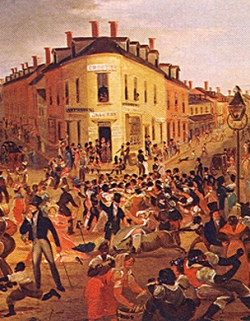
I wonder what the origins of the police are in the Hispanic world?

 The Five Points district of lower Manhattan, painted by George Catlin in 1827. New York’s first free Black settlement, Five Points was also a destination for Irish immigrants and a focal point for the stormy collective life of the new working class. Cops were invented to gain control over neighborhoods and populations like this.
In England and the United States, the police were invented within the space of just a few decades—roughly from 1825 to 1855.
The new institution was not a response to an increase in crime, and it really didn’t lead to new methods for dealing with crime. The most common way for authorities to solve a crime, before and since the invention of police, has been for someone to tell them who did it.
Besides, crime has to do with the acts of individuals, and the ruling elites who invented the police were responding to challenges posed by collective…
View original post 7,122 more words
2014 in review
The WordPress.com stats helper monkeys prepared a 2014 annual report for this blog.

Here’s an excerpt:
A San Francisco cable car holds 60 people. This blog was viewed about 1,500 times in 2014. If it were a cable car, it would take about 25 trips to carry that many people.
Statolatry I: José Rizal is your god and your god hates chickens

There are two concepts which describe an action, used (or at least should be used) in the construction of the laws:
malum in se (Latin: evil in itself; pl. mala in se) and
malum prohibitum (Latin: evil, because it is prohibited; pl. mala prohibita).
Filipinos have been mixing up these two concepts for the longest time. This state of confusion is generally a result of étatism (French: statolatry), the idea that the glorification and aggrandizement of the “Philippine government” or the “Filipino Nation” is the object of all legitimate human aspiration at the expense of all else, including personal welfare and independent thought.
(TL;DR version: Everything the government says should be followed. Ignore useless concepts such as good and evil. Only what is lawful or unlawful as determined by the state matters. Anyone saying different, like people following the dictates of their conscience or religion, are troublemakers.)
On 29 December 2014, the Malacañang Palace Facebook page posted this delightful infographic, once more reminding Filipinos that, not only was José Rizal a sainted political messiah who must be given due veneration, but any challenge to this reality will be met with force by the state.

«Ang̃ mg̃a sumusunod ay báual tuwing Arao ni Rizal» (The following actions are prohibited on Rizal’s Day)
First, take a look at the law mentioned (See: RA 229). The full name of the law is «An act prohibiting cockfighting, horse racing and jai-alai on the thirtieth day of December of each year and to create a committee to take charge of the proper celebration of Rizal day in every municipality and chartered city, and for other purposes.»
Just the title alone reveals the condescension the state feels for its citizens. The assumptions behind this act are:
- What a Filipino does in his free time is not up to him. The state will tell him what to do.
- Filipinos are ignorant of the “martyrdom” of José Rizal whose apotheosis from mere mortal to national hero reflects the divine majesty of the Philippine government. (N.B.: Last time I checked, martyrdom involves voluntarily choosing death for a higher purpose. Rizal was shot by the government only because Bonifacio name-dropped him on just about every KKK document he could write on.)
- Filipinos do not have the mental capacity to observe this civil holiday without state intervention.
- Certain hobbies, lawful on the other 364 days of the year, are incompatible with the holiness of 30 December and are for the next 24 hours to be considered evil.
- Politicians nationwide now have another bureaucracy with which to fill with relatives and gorge from the collected taxes of people.
All this, and I haven’t even gotten to the body of the document!
¿Notice the dire pronouncements that will befall all who disregard the entitlement of the state to intervene in their private lives?
As per §3 of RA 229:
Any person who shall violate the provisions of this Act or permit or allow the violation thereof, shall be punished by a fine of not exceeding two hundred pesos or by imprisonment not exceeding six months, or both, at the discretion of the court.
Imagine that… Six months incarceration. This is the same penalty for:
- Not filling out a census form correctly (CA 591);
- Killing a carabao or a horse without the blessing of the Secretary of Agriculture and Commerce (RA 11);
- Selling tobacco overseas (RA 31);
- Possession of “deadly arrows” (RA 3553);
- Illegal logging (RA 3701);
- Electronic surveillance without a warrant (RA 4200);
- Possession and use of prohibited drugs (RA 6425);
While some may recoil at the thought of incurring arresto mayor for violating this law, most Filipinos dismiss the monetary penalties that accompany RA 229. However, at the time the law was promulgated (9 June 1948), the peso was still legally defined as 12.9 grains of gold 0.900 fine (0.026875 XAU) by the 3 March 1903 Philippine Coinage Act.
(N.B.: It would still be a year before the opening of the Central Bank of the Philippines and the massive estafa by the Philippine government that robbed an entire nation of their savings in gold and silver, replacing it with an ever-depreciationg fiat currency, the modern Pilipine peso.)
Using the 30 December 2014 gold-peso (XAU/PHP) exchange rate of 1 troy ounce of gold = ₱53,973.04, this would mean that an offender in 1948, would be facing a fine equivalent to 5.375 troy ounces of gold or ₱290,105.09 in today’s money. A very hefty sum for any inhabitant who has just survived the Greater East-Asia War. The heavy hand of the state cannot be made much more clear. Be patriotic… or else!

Let us compare Republic Act No. 229 to the original 20 December 1898 decree establishing a day of national mourning:
| GOBIERNO REVOLUCIONARIO | REVOLUTIONARY GOVERNMENT |
|
DE FILIPINAS |
OF THE PHILIPPINES |
|
Decreto |
Decree |
|
SR. EMILIO AGUINALDO Y FAMY, |
MR. EMILIO AGUINALDO AND FAMY, |
|
PRESIDENTE DEL GOBIERNO REVOLUCIONARIO DE FILIPINAS, |
PRESIDENT OF THE PHILIPPINE REVOLUTIONARY GOVERNMENT, |
| CAPITAN GENERAL Y GENERAL EN JEFE DE SU EJERCITO. |
CAPTAIN GENERAL AND COMMANDER-IN-CHIEF OF THE ARMY. |
| Atendiendo á las aspiraciones dcl pueblo Filipino, é interpretando sus sentimientos nobles y patrióticos vengo en decretar lo siguiente: | Heeding the desires of the Filipino people to express their noble and patriotic feelings, I decree the following: |
| Artículo 1º En memoria de los grandes patriotas filipinos Dr. José Rizal y demás víctimas que sucumbieron bajo la extinguida dominación española se declara día de luto nacional el día 30 de Diciembre. | Article 1. In memory of the great Filipino patriot Dr. Jose Rizal and other victims who died under the previous Spanish government, a national day of mourning day is declared on December 30. |
| Art. 2º Con tal motivo desde el medio día, del 29 hasta el medio día del 30 en señal de duelo se izará á media esta la bandera nacional. | Art. 2. For this reason, the national banner shall be flown at half-mast as a sign of mourning from noon the 29th until noon the following day. |
| Art. 3º Vacarán todas las dependencias del Gobierno Revolucionario durante el día 30 de Diciembre. | Art. 3. All government functions of the revolutionary government shall be closed on December 30. |
| Comuníquese y publiquese para general conocimiento. | Communicated and published for general distribution. |
|
Dado en Malolos á 20 de Diciembre de 1898. |
Given in Malolos on 20 December 1898. |
|
El Presidente, —EMILIO AGUINALDO |
The President, —EMILIO AGUINALDO |
¿Notice the difference in tone?
- Apparently, many people, other than Rizal, were executed unjustly by the Spanish government.
- Those people deserve recognition too, not just one man, no matter how high in esteem he was held.
- This decree was written at the request of the Filipino people, not imposed from on high.
- The government, acting as a representative of the people, indicate their mourning by lowering the flag. No more, no less.
- All government offices are closed so that those in the public service can be with their loved ones, either at home or at the cemeteries.
- Being Commander-In-Chief of the Army doesn’t grant the President the right to command civilians.
- There are no injunctions to prevent people from doing anything on 30 December and certainly no six-figure fines for breaking such injunctions.
Perhaps we need to question why Filipinos are so accepting of such petty tyrannies coming from Malacañang.

Lost Filipino Culture: Playing-cards II
Priced at ₱120.00 SRP, the set of cards most familiar to Filipinos today is the Bicycle® «Standard Index Rider Back» line of the United States Playing Card Company. This card pattern is relatively «new» to the Philippine Islands, having only been introduced to the country a little over a century ago by the Americans.
Before this time, Filipinos were much more familiar with a very different set of playing cards, called the naipes españolas (trans. Spanish card Set; lit. Spanish set of playing-cards). This second article in the «Playing-cards» series is written to revive interest in a part of the Filipino cultural heritage that, through state intervention, has been driven to the fringes of society, if not outright extinction.
The development of Latin-suited playing-cards
Moros…
The Spanish word for playing-cards, naipes, as well as the obsolete Italian word for the same, naibi, are both etymologically derived from the Arabic word nã’ib (Arabic: نائب), meaning viceroy. This is in reference to the Moro card game «Mulūk Wanuwwāb» (Arabic: ملوك و نوأب,), or «Kings and Viceroys». (N.B.: See «Lost Filipino Culture: Playing-cards I»)
 Around the 14th century, playing-cards started to emerge from the Moro-occupied territories of Spain and Sicily and started to gain popularity among the neighboring countries and principalities of Europe. Over time, variations in the patterns used to produce playing-cards would emerge and later develop into the modern regional and national playing-card patterns that we see today.
The oldest of these patterns today are found in Spain, Italy, and to an extent, Portugal. Categorized by collectors as the Latin-suit pattern, they have their origins in Mamlūk playing-cards which in turn, descend from earlier Chinese ch’iénk’ǎ (Chinese: 錢卡, trans. money cards).
(N.B.: I will be focusing exclusively on Latin-suited playing-cards from Spain as this particular set is part of the Filipino cultural heritage.)
…y Cristianos
In Spain and Italy, Latin-suited playing-cards only underwent slight modifications from their Moro predecessor. Much of these changes were aimed at simplifying the complicated geometric designs and Arabic inscriptions and remarketing them to local audiences. Without the constraints of Muḥammadan iconoclasm, artists began to visually illustrate the court cards with human figures. Like its Moro counterpart, Spanish playing-cards are unique in Europe in that the court cards do not feature a reina (Spanish: queen).
(N.B.: Some historical sets did feature the reina as a fourth court card, ranking between caballo and rey, but it never gained in popularity among Spanish card players.)


Compared to the 52-card Mamlūk set, Spanish playing-cards only have 48 cards, having dropped the 10-ranked card from each palo (Spanish: suit; pl. palos). The four suits from earlier Moro sets were more or less retained. These would be:
- Oros (Spanish: coins, trans. coins; lit. gold), the oldest direct continuation from the ancient Chinese ch’ién (Chinese: 錢, trans. cash) suit,
- Copas (Spanish: chalices), a direct adaptation of the Moro Tūmān (Arabic: طومان, trans. chalices) suit.
- Espadas (Spanish: swords), in Spain, the swords in the Moro Suyūf (Arabic: سيوف, trans. scimitars) suit were changed to more European straight broadsword model (N.B.: In Italy, Latin-suited playing-cards use curved sabers.),
- Bastos (Spanish: batons), as jawkān was an obscure sport for Europe, the Moro Jawkān (Arabic: جوّكان, trans. polo-sticks; lit. polo) suit was replaced by representations of wooden cudgels (N.B.: In Italy, Latin-suited playing-cards use ceremonial batons.).

As (Spanish: Ace) cards showing the four palos of the Spanish set: oros, copas, espadas, and bastos. Taken from «Cuatro elementos», photograph by Domingo Caceres, © 2012.
The three court cards, which in previous Moro sets were identified only by their names, were transformed into the sota (Spanish: knave), the caballo (Spanish: cavalier; lit. horse), and the rey (Spanish: king).
Court cards on Spanish playing-cards are single headed, meaning the subject is not reversible.
[pic of cards]
To the delight of playing-card collectors, different regions in Spain have produced a number of variant patterns, which will be discussed later in this article. Regardless of the pattern used by the manufacturer, the subject of each card in a Spanish set is framed by a border, called pintas (Spanish: marking),which assist the player in identifying each suit by the number of interruptions along the upper and lower marginal lines. in the upper and lower marginal lines of every card,

The 48-card variant of Spanish set is sometimes marketed as containing 50 cards since it sometimes includes two additional wildcards, the comodines (Spanish: jokers; sing. comodin). Another difference between French and Spanish sets and is that comodines have no fixed subject. Manufacturers have the discretion of placing anything they want on it.
During the 17th century, the 8s and 9s began to be purposely removed, prompting playing-card manufacturers to produce deliberate 40-card sets in response to market needs. Many traditional card games from Spain, Italy, and Latin America, (and to some extent, Portugal and France) only use 40 cards in play.
These 40-card sets are the most extensive variant of Spanish playing-cards found across the globe. They are in general manufacture in the former territories of the Spanish Empire and, unlike in the Philippine Islands, not viewed suspiciously by the authorities as a harbinger of organized crime.
A hybrid 54-card French/ Spanish set (N.B.: 52 cards plus 2 comodines) based on the French set, but using Latin suits also exists. Known as poker española (Spanish: Spanish poker), it was first produced by Barcelona card manufacturer Naipes Comas S.A. (1797-1992) early in the last century. The poker española set is designed to allow Spaniards to play non-Spanish games while still retaining a familiarity with the set being used. The design is currently produced by Naipes Heraclio Fournier S.A., borrowing imagery from its Castilian pattern.
[pic of cards]
Variants of Latin-suited playing-cards in Spain
The first Baraja Española
The common design for Latin-suited playing-cards in Spain took several centuries to stabilize into the first Baraja Española (trans. Spanish National Card Design; lit. Spanish set of playing-cards). Various manufacturers would add decorative features to their sets, much of their meanings now lost to time and myth.
Lost elements from c. 1500 A.D. sets include a child hosting the as de bastos, the Aragón coat of arms on the 2 de oros, a six-pointed star on the 4 de oros, and two heads, supposedly representing Ysabel I de Castilla and Ferrando II d’Aragón, on the central coin of the 5 de oros. Other elements retained their longevity and still remain in modern cards such are the pintas that appeared c. 1600 A.D. and the unusual inscription «Ahí va», found on some caballo de copas.

Baraja Española Gótica siglo XVII facsimile manufactured by Naipes Heráclio Fournier, S.A., 1983. 40 cards. Taken from World of playing-cards.
The Baraja Española was fairly stable for about three centuries until the Industrial Revolution when manufacturers and graphic artists experimented with new printing techniques to replace older traditional hand painted woodblock printing.
(N.B.: Another Catalonian playing-card manufacturer, Juan Roura S.A. (1872 – 1962) would hold the virtual monopoly on the sales of Spanish playing-cards to the Philippine Islands until its acquisition by Naipes Heraclio Fournier S.A. in 1962.)
The «Spanish Catalán» pattern
The «Spanish Catalán» pattern (N.B.: As opposed to the «French Catalán» pattern.) has become well-established in Latin America these days, more so than in Spain where the design originated in the nineteenth century. Barcelona card manufacturer and exporter Naipes Comas S.A. was primarily responsible for the widespread popularity of this pattern outside Spain. The main features of this pattern are:
- The oros suit shows rounds with geometric patterns instead of stylized coins;
- The as de oros shows a central female bust in profile, within a wreathed and crowned circular frame. This is mounted on a low platform carrying symbols of commerce and prosperity – barrels, cornucopias, anchors, etc., with flags draped at the sides.
- The chalices of the copas suit are open;
- Apart from the as de espadas, all the swords in the espadas suit are of one design;
- The cudgels of the bastos suit are knobbier and have more prominent branches, particularly on the as de bastos;
- The as de bastos doesn’t have a ribbon wrapped around the cudgel.
- The horses featured on the caballo cards are disproportionately small compared to the cavaliers riding them;
- The horses featured on the caballo cards are rampant (N.B.: rearing up on their hind legs.);
- The kings featured on the rey cards are clean-shaven, although some variants of the «Spanish Catalan» pattern portray the kings with moustaches.

«El Ciervo» Spanish Catalán pattern, c.1930, Sebastian Comas y Ricart – Hija de A. Comas.
The «Castillian» pattern
While the «Spanish Catalán» pattern gained ascendance in Spain, this did not mean that other patterns were abolished. It was, in fact, another distinctive style of Latin-suited playing-cards, referred to by collectors as the «Castillian» pattern which would become the new national design of Spanish playing-cards.
The modern «Castillian» pattern was designed (c. 1877-1887 A.D.) by graphic design artists working for the Spanish playing-card maker Naipes Heraclio Fournier S.A.; soon to become the largest playing-card manufacturer in Europe. Their design remains the standard of production even today.
(N.B.: However, Heraclio Fournier was acquired in 1986 by the United States Playing Card Company, and in 2004, both companies in turn becoming brand subsidiaries of Jarden Corporation.)
The «Castillian» pattern has several distinctive elements:
- The oros suit uses stylized coins featuring a head in profile;
- The chalices of the copas suit are usually topped by a lid;
- There are three sword designs in the espadas suit;
- The as de espadas features a sheathed saber with ribbon;
- The swords held by personages in the court cards plus the ones featured on cards 2 and 3 are long and straight while the remaining cards, 4-7 (or 9 in the 48-card variants) are short and triangular;
- The cudgels of the bastos suit are smooth, with a narrow handle and a broad rounded end;
- The as de bastos has some leafy twigs and is wrapped by a ribbon.
- The horses featured on the caballo cards are not rampant and are proportionate to the cavaliers riding them;
- The kings featured on the rey cards all have beards.
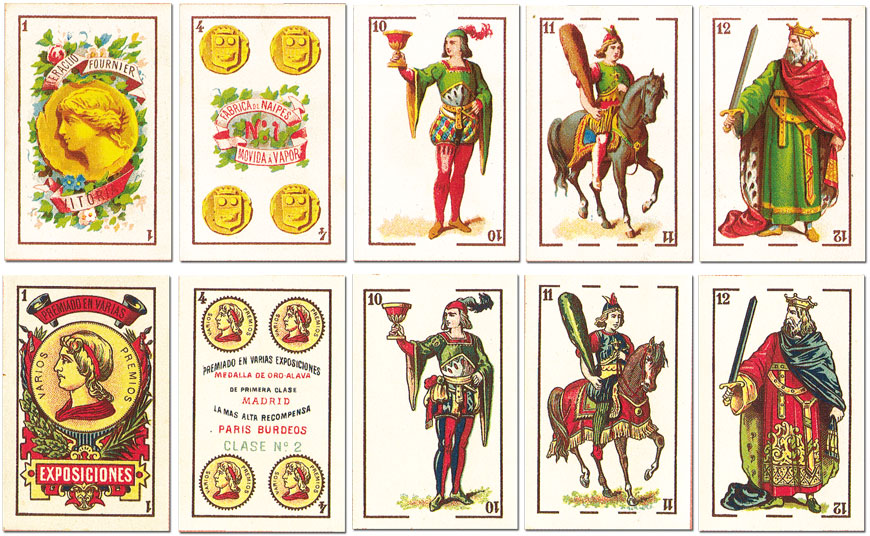
Above: First issue of the house pattern by Naipes Heraclio Fournier S.A., 1877.
Below: 1887 revised design, which became the modern «Castilian» pattern used today around the world.
Spanish state-monopolies
The State criminalizes the entrepreneurs «for the good of the people»
The emergence of nationalism and étatism as the dominant political philosophies of Europe began to infect Spanish state-policy around the 15th century. Among them, the championing of mercantilist economic practices which destroyed the budding entrepreneurial system that had been slowly and organically replacing the older failed system of guild protectionism.

Statue of Felipe II de España, located in Intramuros, Manila.
In 1543, Felipe II «el Prudente» of Spain declared a state-monopoly on the manufacture and sale playing-cards (N.B.: A precedent which would include many other industries ranging from tobacco to platinum, etc.). This monopoly was to be divided into several regions including Aragón, Toledo, Castilla, and Sevilla as well as México and Nueva España (N.B.: including the Philippine Islands were included.) and leases for these respective monopolies were to be awarded on a competitive basis to the highest bidder and subject to onerous and often arbitrary state controls.
By royal fiat, the private manufacturing or importation of playing-cards were made criminal offences, if pursued without the royal patent.
For the next 260-odd years, production and sale of playing-cards were to be reserved solely to the state. Fortunes across the empire were ruined, as private manufacturers were forced to shut down in the face of state usurpation of private entrepreneurship.
While the favored lease-holders may have enjoyed laws protecting them from trade competition, they were also required to sell their playing-cards at fixed prices regardless of production costs. As a result, very little innovation occured, and the quality of playing-cards manufactured around this time was very poor.
Latin-suited playing-cards in the Philippines
Disruptions in the lives of our ancestors as a result of the Spanish state-monopoly

«Panguingue» by José Taviel de Andrade (1895). Oil on canvas. 61 cm. x 88 cm.
The earliest playing-cards in the Philippines were independently introduced to the country by Chinese settlers. Along with trade and commerce, the Chinese diaspora brought along with them a number of playing-cards, which outside of the Chinese expat community, and perhaps the older Lán-nâng (Hok-kiàn: 咱儂; trans. Fúchiènese-Filipinos), remain largely unknown today.
Chinese playing-cards introduced to the Philippine Islands included hsiàngch’í-p’ái (Chinese: 象棋牌, trans. chess cards), chǐh-kǔp’ái (Chinese: 紙骨牌, trans. domino cards), and máchiàng-chǐhp’ái (Chinese: 麻將紙牌, trans. mahjongg playing-cards). (N.B.: See «Lost Filipino Culture: Playing-cards I»)
When the Philippine state was established in 1571, the new Spanish colonial administration was obliged to enforce Spanish protectionism in the playing-card market, then it its 28th year. The imposition of the Spanish monopoly not only effectively halted the importation and sale of new Chinese playing-cards into the country, but it also produced a number of unintended consequences to Filipino gaming norms which still reverberate to this day, over four centuries later.
One unintended consequence of the Spanish state-monopoly laws is the way Filipinos view games like Chinese dominos and mahjongg. Even with the availability of cost-effective playing-card alternatives on the Internet, most domestic gamers don’t even realize that this option even exists and so, these games are always played exclusively using tiles.
This preference, (if you can call it that), for tiles over playing-cards is because our ancestors, having no recourse to the law in order to continue freely exercising their consumer preferences, took advantage of the fact that the Spanish playing-card monopoly law made no mention of duties to be imposed for playing-tiles and have ad the practice ingrained ever since. (N.B.: The earliest example of tax-avoidance in the Philippines.)
Another example would be that our ancestors, realizing that a permanent shortage of replacement playing-cards from China was inevitable (N.B.: and seeing that the risk-to-reward cost ratio of smuggling playing-cards was unprofitable to attempt such as venture), began to directly adapt Chinese card games in order function with Latin-suited playing-cards. (N.B.: More on these card game in a future article.)
The «Cádiz» pattern
The Spanish playing-card monopoly lasted almost three centuries before finally being abolished in 1811. With the deregulation in the industry, private playing-card manufacturers in Andalucía and elsewhere began producing playing-cards for both domestic consumption and export. Many new patterns emerged from this region, but only the «Cádiz» pattern, named after the province it originated in, survived to the present day.
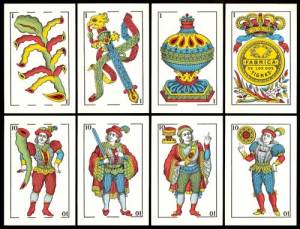
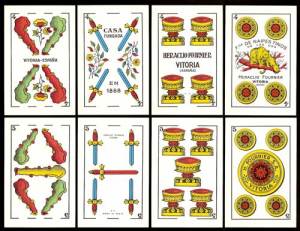
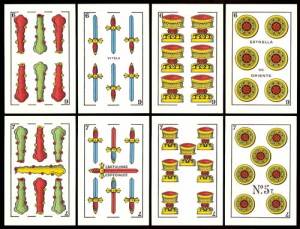
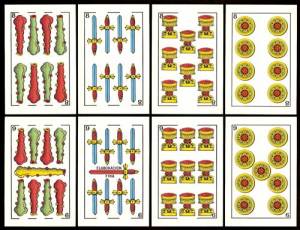
The «Cádiz» pattern is very fascinating to playing-card collectors because, though produced in the modern era, its graphical elements retain the woodblock printing look of early Spanish sets. Because Cádiz hosted numerous port cities, these playing-cards easily found their way to to Spanish territories in Africa, South America, and Asia. When the modern «Castilian» pattern became the national design of Spanish playing cards (from the early 1900s onwards), popularity of the «Cádiz» pattern was on the wane. Today, the «Cádiz» pattern is no longer offered on the website of Heraclio Fournier. However, the pattern had managed to survive and is domestically reproduced in countries the set was originally exported to. Of interest is Catalonian manufacturer, Juan Roura S.A. which produced «Cádiz» pattern playing-cards under a number of brands including Dos Mundos, La Hispano-Americana, La Legítima Loba, El Toro, and Dos Toros. (N.B.: The «Dos Tigres» and «Dos Toros» brands are the ones most likely to be recognizable by older Filipinos.) Elements of the «Cádiz» pattern are easily recognizable:
- «Cádiz» pattern sets usually have sharp square corners rather than rounded ones as found on other sets;
- The sota de oros features a hound tied to a pole;
- The chalices of the copas suit are open and feature a cylindrical bowl decorated with diagonal bands;
- The caballo de copas bears the inscription «Ahí va», an exclamation whose relation with the card remains obscure;
- The cudgels of the bastos suit are even knobbier than the ones featured in «Spanish Catalan» sets; and have more prominent branches, particularly on the as de bastos;
- Design of the personages on the court cards are reminiscent of medieval illustrations.


The politics of prohibition

Filipinos gambling during a wake.
The Philippine Islands are among the few Asian-Pacific countries of the former Spanish East Indies where the use of «Cádiz» pattern playing-cards is still reported to be in use, though sadly, rarely for the card games they were intended to be played with. Here, Latin-suited playing-cards are now popularly associated in the public mindset with carnival charlatans and gambling operators who run an illegal matching game called sakla (Tagálog: no trans.) during funeral wakes.
This current state-of-affairs is unnatural. Just like firearms and recreational pharmaceuticals, there is nothing inherently malum in se (Latin: inerently evil) in playing-cards, no matter what pattern is used in their design. So how did an ordinary leisure activity fall almost entirely out of public use and into the grip of criminal activity?
Cultural shifts in Filipino society and neglect over time may be in part to blame for this extinction. However, students of Prohibition-era America will recognize that the unwarranted felonious reputation that Latin-suited playing-cards have among Filipinos today is a result of over four centuries of deliberate political action by the Philippine State.
It is not disputed that playing-cards have had a rather tentative relationship with both religious and civil authorities ever since their creation. The earliest references (c. 1370-1380 A.D.) we have of playing-cards also include legislation banning their sale and use. Dice and board games were already well established in society so the addition of playing-cards to the available leisure activities was warmly received. However, games of chance always do seem to attract the less savory elements of society.
The end-results of the Spanish trade-monopoly laws
Towards the waning years of the Spanish administration, idleness and gambling in Filipino society had reached almost epidemic levels, prompting the already overburdened and underequipped law authorities to crack down. Three centuries of Spanish restrictions on trade and entrepreneurship had produced an idle society which viewed entrepreneurship as an activity bereft of dignity.
In the popular perception of the time, the place of the Spanish and Filipino gentleman was in the law courts and the government offices. The only section of Philippine society wherein trade and commerce were pursued normally, were the Lán-nâng. (N.B.: There is a reason why 28(?) out of 50 people listed in Forbes business magazine’s article «Philippines’ 50 Richest» are Lán-nâng.) The rest of the economy was left to be managed almost entirely by the women of the Spanish and Filipino households, who by social norms did no manual labour, relying such tasks to be left to hired hands from the uneducated classes.
In such an environment, wherein legitimate enterprise is viewed with disdain, people begin to develop and attitude of fatalism; that personal and household improvement is impossible and relegated to the whims of suerte (Spanish: luck; lit. fate), gambling ceases to exist as a form of recreation and moves into the realm of vice.
The American administration
a

Newspaper editorial railing against the evils of «Panguingue», a rummy card game, popular in the 19th- and early 20th-century.
Unfinished, but posted early. To be continued…
The Founding of Manila and the Origin of Global Trade, 1571
Ancient history or current events?

In 1995, historians Dennis O. Flynn and Arturo Girldez published a seminal article in the Journal of World History entitled “Born with a ‘Silver Spoon’: The Origin of World Trade in 1571.”
Global trade emerged with the founding of Manila in 1571, at which time all important populated continents began to exchange products continuously. The silver market was key to this process. China became the dominant buyer because both its fiscal and monetary systems had converted to a silver standard; the value of silver in China surged to double its worth in the rest of the world. Microeconomic analysis leads to startling conclusions. Both Tokugawa Japan and the Spanish empire were financed by mining profits–profits that would not have existed in the absence of end-customer China. Europeans were physically present in early modern Asia, but the economic impact of China on Western lands was far greater than any…
View original post 12 more words


 Acts of the New Commonwealth